


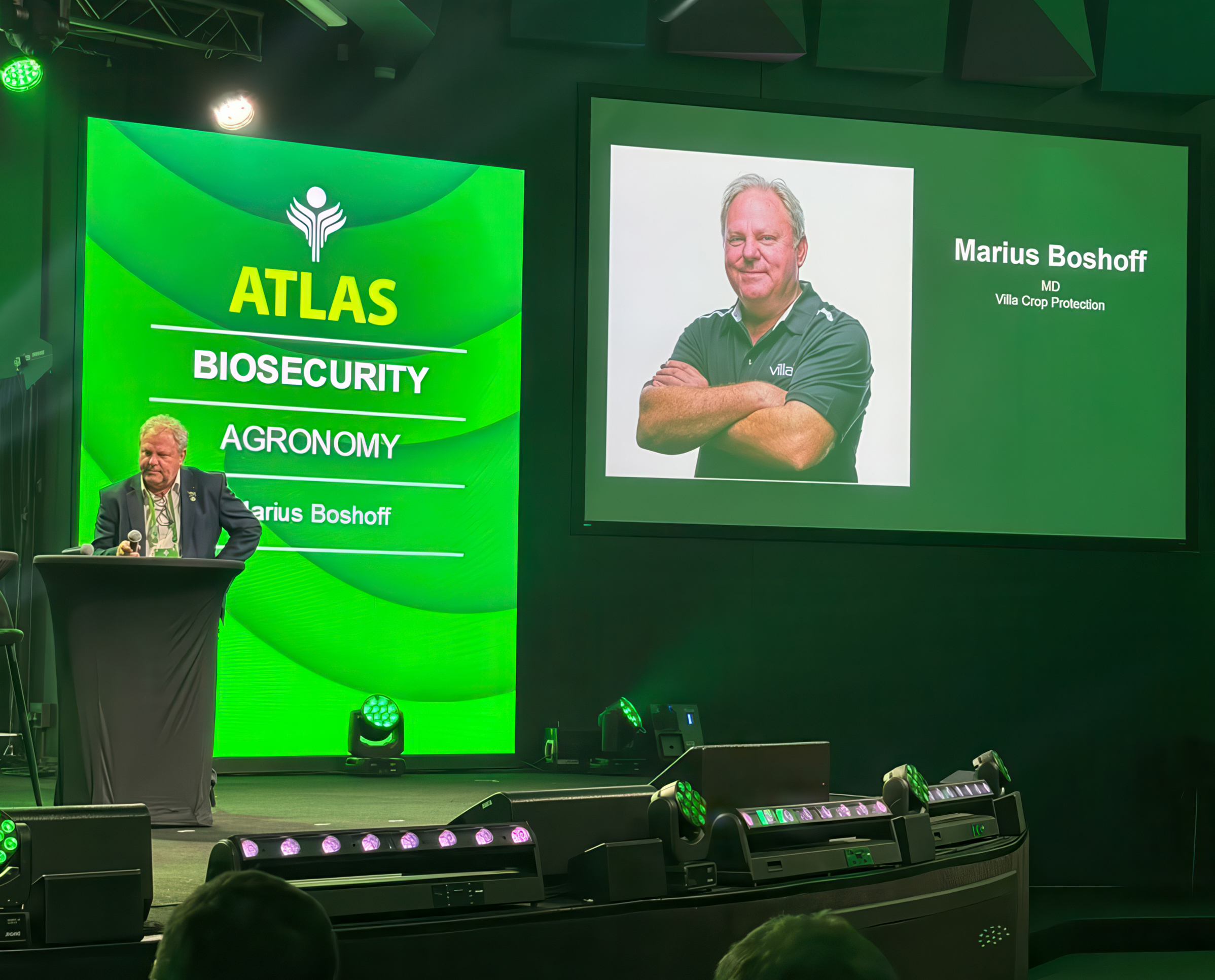
Villa MD Marius Boshoff has been closely involved in the role CropLife SA plays in the South African agricultural landscape
Marius Boshoff’s career in agriculture spans more than 30 years, of which 25 were spent in the crop protection arena. During this time, he has seen the industry representative body evolve from AVCASA (the Association of Veterinary and Crop Associations of South Africa) to today’s internationally affiliated national body for suppliers and distributors of crop protection products.
Moreover, it was under his guidance that CropLife SA’s current organisational structure was established in 2018 when the body strategically enhanced its mandate. He is currently serving his third stint as CropLife SA president.
“As suppliers and distributors of crop protection products, we find ourselves in a very complex environment,” he says. “You are not only dealing with the regulatory environment now and in future, but it is also about keeping the industry professional. There are interactions about the proper management of agricultural remedies, about establishing how to manage product resistance and how to maintain good stewardship throughout the product life cycle.”
In current market conditions, amid a slew of regulatory changes and new requirements, it is difficult to imagine trading in crop protection products without CropLife SA advocating for the industry and negotiating implementation timelines on behalf of some 100 member companies. And one of the reasons industry can look to CropLife SA to address a myriad of pressing questions about new and challenging regulatory requirements – such as label changes, product withdrawals and traceability obligations – is the CropLife executive’s deliberate efforts to position the organisation strategically to respond to the needs of both the industry and the broader agricultural community.
“It is common sense that we as an industry should work together on matters such as regulatory compliance and stewardship; we have more than 100 member companies, and more than 30 of them specialise in conventional agrochemicals, along with suppliers of various biological agents and seed treatments,” Marius says.
Several key appointments made at CropLife during the 2018 restructure of the organisation are still full-time staff members.
Industry voice and product stewardship
In the past seven years, industry benefited significantly from CropLife SA’s communication of new regulatory requirements. These include the introduction of GHS (Globally Harmonized System of Classification and Labelling of Chemicals) packaging and labelling, followed by the more recent withdrawals of highly hazardous pesticides, and the introduction of pest control operator requirements and traceability of restricted agricultural products.
“CropLife SA plays an outsize role in terms of communication and interaction with the Registrar [of Act 36 of 1947] as well as the general public,” Marius says. “It has managed to position itself to provide input on pressing regulatory issues, and accordingly the Registrar is engaging with industry through this organisation.
“Absent an organisation like CropLife SA, every company would have to interact with the Registrar separately, and that would have been chaotic.”
Mission-critical volunteers
For Marius, there is a disconnect between the voluntary nature of the organisation and the crucially important work it does, noting that CropLife is a non-profit organisation and its members join voluntarily. There are no statutory requirements to be a CropLife member in South Africa to trade in crop protection products.
“Besides interactions around legislation, CropLife SA also facilitates discussions on best practice and the responsible management of agrochemicals and related technologies. A key aspect of this involves managing pest resistance to products. Within CropLife SA, this work takes place through HRAC, FRAC and IRAC – the Herbicide, Fungicide and Insecticide Resistance Action Committees – where professionals collaborate, again voluntarily, to develop practices that help reduce resistance by alternating different active ingredients. In addition, CropLife SA manages the Extended Producer Responsibility (EPR) schemes, as required by law, which ensure the cradle-to-grave management of packaging waste in South Africa.
“As an industry, we primarily take guidance from the scientific community, and from there CropLife SA communicates recommendations for more responsible and sustainable use of products. It is an enormous task that no single company can perform on its own; you have to approach these things from the industry as a whole.”
CropLife SA is the only organisation managing a comprehensive database of registered agricultural remedies, Agri-Intel, and for that it also relies on members submitting up-to-date information on all its product registrations.
It is a testament to the efficiency and expertise of CropLife SA’s staff that the organisation is the first point of contact for any media reporting on pesticides. Although general media coverage of the industry is often negative, CropLife SA consistently provides comprehensive and measured feedback. On more contentious issues, many member companies even rely on CropLife SA to respond on their behalf.
“And yet we often also get criticism from people within the industry who don’t stay abreast of communications, asking why they pay membership fees and why CropLife doesn’t take a more aggressive approach towards government when it bans our products,” he says.
The last time industry litigated against the Registrar was in 2010, when the then AVCASA obtained a court order compelling industry and the Registrar to jointly establish a way to eliminate the backlog in product registrations. CropLife SA’s current leadership understands the value of collaboration, and both the organisation’s management and staff have a cordial working relationship with the office of the Registrar.
Flipping the script
Marius feels strongly that CropLife SA’s role should be legislated in order to support its ability to hold industry to account and add impetus to its efforts to professionalise it. The organisation has a code of conduct that binds members to ethical conduct and provides for sanctions should members not comply with the code.
For Marius, it is deeply concerning that the crop protection industry and agriculture are held accountable for infractions and tragedies beyond its control while systemic causes of such problems are left to fester. However, the one silver lining of the position in which the industry finds itself is that it will be involved in talks around the revision of Act 36 of 1947, and along with it the potential to convince government of the value of a professionalised crop protection industry that manages to safeguard South Africa against many of the problems facing other African countries.
“As an industry, we are largely self-regulating. If a grower encounters an adverse problem related to agrochemicals, they won’t hesitate to institute a claim against you. It is because of this self-checking nature of the industry that we don’t have the problems with unregulated counterfeit agricultural remedies found in many other African countries.
“But this could become a problem in South Africa if the status quo continues. We are therefore hoping that government appreciates the benefits of introducing an environment that is enabling for business.”
In reflecting on his tenure at CropLife SA, Marius emphasises the strategic value of his commitment.
“The time and effort invested at CropLife is not just about representing our members but also about building trust and credibility with all stakeholders, ensuring our industry’s voice is heard where it matters most.”
For him, the collaborative leadership of member companies is essential for the effective functioning of the crop protection sector, especially within a culture of compliance and scientific integrity.