


Using seaweed biostimulants to support crops from establishment through the season
The first weeks after planting can set the ceiling for the harvest. South African field trials in maize, soybeans, dry beans and peanuts show why biostimulants are increasingly being considered as part of an early, evidence-led crop-management programme.
Yield potential is built from planting onwards, while roots are establishing, seedlings are competing for water and nutrients, and the crop is setting up the structures that will carry it through the season.
That makes the opening weeks a critical management window. A poor start cannot always be corrected later, even when rainfall improves or a crop receives adequate nutrition. Uneven emergence, restricted rooting and early stress may already have narrowed the crop’s potential.
With variable soil moisture at planting and uneven rainfall within a single season, strong crop establishment is the first investment in yield stability.
Biostimulants are not intended to replace good seed, balanced nutrition, soil correction, weed control or sound agronomy. Nor are they an insurance policy against drought. Used well, they are an additional management tool that can support the plant’s natural physiological processes and help it make better use of available resources.
Proactive management begins before stress appears
Kelpak® is derived from Ecklonia maxima, a kelp species that grows in the dynamic waters off South Africa’s west coast. Its cold Cellburst extraction process is designed to preserve naturally occurring bioactives in the kelp, differentiating Kelpak® from other Ecklonia maxima derived products. When applied to crops, the extract supports root development and physiological pathways associated with growth and stress tolerance.
A crop with a stronger root system has a larger platform from which to explore the soil for moisture and nutrients. Supporting that system early may help the plant manage periods of abiotic stress more effectively. A later foliar application can then reinforce the programme during an important vegetative or reproductive stage.
Maize: the strongest response came from combining timings
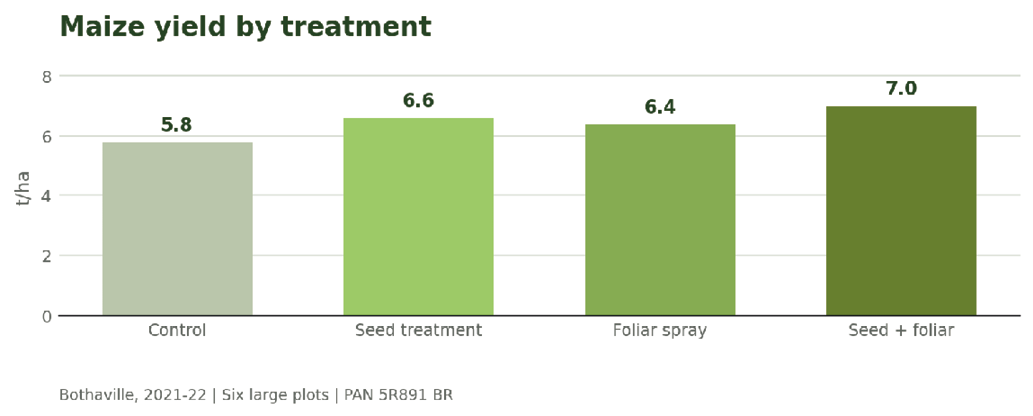
A large-plot maize trial at Bothaville tested Kelpak® under conditions intended to more closely simulate on-farm production and reduce the variation sometimes seen in small plots. Six plots were used, with Kelpak® applied either as a seed treatment at 5 mL/kg seed, as a foliar spray at 2 L/ha, or as a combination of the two.
The untreated control yielded 5.8 t/ha. Seed treatment alone produced 6.6 t/ha, a 14% increase, while the foliar treatment alone produced 6.4 t/ha, a 10% increase. The combined programme delivered the highest yield at 7.0 t/ha, 21% above the untreated control.
This trial suggests that establishment and in-season support can perform different jobs. Treating the seed places the intervention at the beginning of root and shoot development. The foliar spray at the three- to five-leaf stage follows when the young plant is expanding its canopy and building capacity for later growth. In this trial, the layered programme outperformed either timing on its own.
Tip: If biostimulants are used only once visible stress has developed, part of the management opportunity may already have passed. This Bothaville result suggests that planning the treatment around crop development can be more useful than positioning it as a late rescue response.
Soybeans: a signal under severe moisture pressure
The soybean trial near Potchefstroom tested several seaweed-based biostimulants in large plots. Conditions were exceptionally dry, with less than 150 mm of rain recorded during the growing season.
Against a low-yielding untreated control of 355 kg/ha, Kelpak® produced 423 kg/ha, a numerical improvement of 19%.
The absolute yields remained commercially low. Within the same severely water-limited field, the Kelpak® treatment produced the highest yield among the seaweed products tested.
Dry beans: building the programme across growth stages
A 2025 sugar-bean trial at Groblersdal compared seed treatment, individual foliar timings and combined programmes. The untreated control yielded 2.22 t/ha. Seed treatment alone increased yield numerically to 2.41 t/ha, while foliar applications at V4 and R1 produced 2.59 t/ha and 2.63 t/ha respectively.
The highest yield, 2.80 t/ha, came from Kelpak® seed treatment followed by foliar applications at both V4 and R1. This represented a 26% numerical increase over the control.
The full treatment produced the highest numbers of seeds per pod and pods per plant, and the seed-per-pod response differed significantly from the control and several other treatments.
This helps explain how an early programme may influence the route to yield. Crop stand, reproductive development, seed number and seed weight all contribute to the outcome. The Groblersdal trial indicates that the most complete programme supported several of these components, with the strongest numerical yield response where seed and foliar applications were combined.
Peanuts: useful evidence, with an important qualification
An Alma, Limpopo, peanut trial provides a further example of an integrated biological programme under dry and stressful conditions. Kelpak® was applied with Biocult® Mycorrhiza in-furrow, followed by either one or two Kelpak® foliar applications. The untreated control produced 1,405.8 kg/ha of shelled peanuts. The top treatment–the combined in-furrow treatment followed by two foliar applications–yielded 2,664 kg/ha, an additional 1,259 kg/ha.
Because Kelpak® was applied alongside Biocult® Mycorrhiza in-furrow, the yield response cannot be attributed to Kelpak® alone. The trial’s value lies in showing how seaweed biostimulants may be integrated with other biological tools and timed around operations already taking place, such as planting and rolling.
Turning trial percentages into farm decisions
Across these four crops, the recurring pattern is that timing and programme design matter. Seed or in-furrow applications place support at establishment; foliar applications add another intervention at a defined stage; and, in the maize and dry-bean trials, the combined programmes produced the largest numerical yield responses.
Soil condition, rainfall, temperature, planting quality, nutrition, tank-mix compatibility and application accuracy can all affect the response. Farmers should therefore assess replicated local evidence, follow registered label guidance and work with an agronomist to fit any biological input into the wider programme.
Adoption should start with a clear objective, such as improving early rooting, stand uniformity, reproductive development or performance under limited moisture. That objective determines the application window and relevant measurements. Recording emergence, plant population, rainfall, crop stage and final yield builds a useful farm record. Over several seasons, those records show whether a response is repeatable enough to support a commercial decision.
These South African trials suggest that biostimulants are most useful when planned around plant development rather than added after stress becomes visible. Kelpak®’s role is best understood as part of proactive crop management: supporting the plant early, reinforcing it at relevant growth stages and helping the crop express the yield potential present in the seed, soil and season.
Kelpak®’s cold Cellburst process, consistent formulation and long-term field evidence distinguish it from other Ecklonia maxima-derived inputs, particularly under abiotic stress. 
For more information on Kelpak®, visit www.kelpak.com