


Okra, the climate-smart crop
An ancient vegetable with modern potential is quietly transforming livelihoods in some of Limpopo’s rural communities.
In the fields of northern Limpopo, a crop once regarded as a minor garden vegetable is steadily gaining commercial significance. Okra, known for its distinctive green pods and remarkable nutritional value, is emerging as one of South Africa’s most promising underutilized crops. As farmers search for climate-resilient and profitable alternatives to conventional crops, okra is proving that it deserves a place in the country’s agricultural future.
From the villages of Gumbu and Mayephu in the Vhembe District, farmers are demonstrating that this humble vegetable can generate income, support household food security, and connect rural producers to lucrative urban markets in Johannesburg and Pretoria.
Why okra matters
Okra (Abelmoschus esculentus) is a warm-season crop believed to have originated in Africa. It is widely consumed across the continent, Asia, the Caribbean, and parts of the Americas. The young green pods are used in soups, stews, and vegetable dishes, while the leaves and seeds can also be utilized for food and other purposes.
Despite its long history and adaptability, okra remains largely underutilized in South Africa’s formal agricultural sector. Most commercial vegetable production focuses on crops such as tomatoes, cabbages, spinach, onions, and potatoes, while indigenous and traditional vegetables often receive limited attention from researchers, policymakers, and mainstream markets.
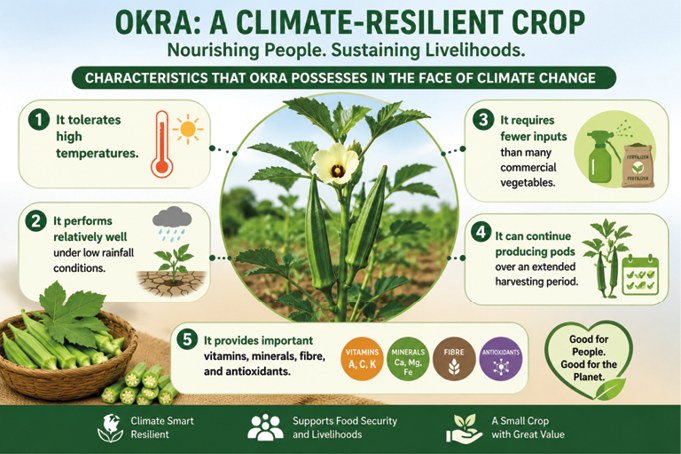
Yet okra possesses several characteristics that make it particularly relevant in the face of climate change (Figure 1):
These attributes make okra a valuable crop for smallholder farmers operating in drought-prone regions.
A growing success story in Gumbu and Mayephu
In the villages of Gumbu and Mayephu, located in the Musina and Collins Chabane Local Municipalities, respectively, farmers have been cultivating okra for many years as part of local food traditions. However, recent years have seen a growing recognition of its commercial value.
Farmers in these communities are increasingly producing okra not only for household consumption but also for sale to local traders, community markets, and urban buyers. During the harvesting season, fresh okra harvested from village fields makes its way to major markets in Johannesburg and Pretoria, where demand continues to grow among consumers from diverse cultural backgrounds.
The crop has become an important source of supplementary income for many households. Because okra can be harvested repeatedly over several weeks or months, farmers are able to generate regular cash flow throughout the production season.
Local traders often purchase fresh pods directly from producers, reducing marketing challenges and allowing farmers to focus on production. In addition, some producers sell directly to consumers within their communities, ensuring that local households have access to fresh and nutritious vegetables.
Meeting Demand Beyond Limpopo
Urbanisation and increasing cultural diversity in South Africa have contributed to growing demand for traditional vegetables, including okra. Consumers from various African countries, as well as South African communities with a long tradition of okra consumption, actively seek the vegetable in fresh produce markets.
Markets in Johannesburg and Pretoria have become important destinations for okra produced in Limpopo. Fresh produce traders recognise the crop’s value and often source supplies from rural producers during peak production periods.
This market linkage demonstrates an important lesson for agricultural development: crops do not need to be mainstream to be profitable. Niche markets can provide significant opportunities for smallholder farmers when production is aligned with consumer demand.
Nutrition hidden in a green pod
Okra is often referred to as a “super vegetable” because of its impressive nutritional profile (Table 1). It is particularly valuable because it is: (continued on page 16)
- Low in calories and fat but provides useful dietary fibre.
- A good source of vitamin C, vitamin K, folate, calcium, magnesium and potassium.
- A source of mucilaginous soluble fibre, which gives cooked okra its characteristic slimy texture and contributes to its dietary-fibre content.
- Rich in various bioactive compounds and antioxidants, including polyphenols and flavonoids.
The characteristic mucilage, the gel-like substance released during cooking, is valued for its culinary properties and has been associated with various health benefits. Regular consumption of okra can contribute to improved nutrition and dietary diversity, particularly in rural communities where access to a wide range of vegetables may be limited.
In a country where malnutrition and micronutrient deficiencies remain challenges in many areas, promoting nutrient-rich traditional crops could contribute to healthier diets.
Climate resilience for the future
Climate scientists predict that many parts of South Africa will experience higher temperatures, more frequent droughts, and increasing rainfall variability in coming decades.
These conditions pose significant risks for conventional crops that require substantial water and external inputs. Under such circumstances, resilient crops like okra may become increasingly important.
Farmers in Gumbu and Mayephu villages have long observed okra’s ability to withstand periods of heat and water stress better than many other vegetables. While no crop is completely immune to drought, okra’s natural resilience makes it an attractive option for climate-smart agriculture.
The crop’s adaptability aligns with growing calls to diversify South Africa’s agricultural systems and reduce dependence on a narrow range of crops.
Challenges limiting wider adoption
Despite its potential, several challenges continue to limit the expansion of okra production (Figure 2).
Unlocking the potential of underutilized crops
The success of okra farmers in Gumbu and Mayephu villages highlights the broader potential of underutilized crops in South Africa.
As policymakers, researchers, and development organisations seek solutions to food insecurity, climate change, and rural poverty, greater attention should be given to crops that have sustained communities for generations.
Investment in research, seed systems, value chain development, and market promotion could help transform okra from a niche crop into an important contributor to rural livelihoods and agricultural resilience.
The experiences of Limpopo farmers show that innovation does not always require introducing new crops. Sometimes the answer lies in rediscovering and supporting crops that communities have quietly cultivated for decades.
The road ahead
Okra may not yet occupy the same status as maize, tomatoes, or potatoes in South African agriculture, but its future appears increasingly promising.
In villages such as Gumbu and Mayephu, farmers are proving that traditional crops can generate income, strengthen food security, and connect rural communities to urban markets. Their success serves as a reminder that South Africa’s agricultural future may depend not only on modern technologies but also on the rich diversity of crops already present in its fields.
As climate pressures intensify and the search for resilient farming systems continues, the green pods of okra could become an important symbol of a more diverse, sustainable, and food-secure agricultural future. 
Dr Matelele Lehlogonolo*, Mr Fakude Sithembiso, Ms Maluleke Nkat & Ms Sema Precious
National Department of Agriculture, Directorate Genetic Resources, National Plant Genetic Resources Centre
*Correspondence: LehlogonoloMa@nda.gov.za / matelelela@gmail.com