


Preserving crop diversity today to build a more resilient food system tomorrow
Aseed may look small, but it carries an enormous inheritance. Within it lies genetic potential that farmers may need tomorrow to cope with drought, heat, pests, diseases, poor soils and changing markets. For generations, South African farmers have selected, saved, exchanged and planted seeds suited to local conditions, helping maintain an extraordinary agricultural heritage.
This heritage includes traditional crop varieties, farmer-selected landraces, indigenous vegetables and neglected and underutilized crops. Together, these plant genetic resources are a reservoir of diversity that can contribute to food security, nutrition, climate adaptation and future crop improvement.
Yet this diversity is under pressure. The replacement of locally adapted varieties with a narrower range of commercial varieties, changing farming practices, urbanization, environmental degradation and the loss of traditional knowledge can contribute to genetic erosion.
The question is therefore not simply to preserve seeds, but to keep useful diversity alive in farmers’ fields and in the hands of the people who use it.
This is where agroecology can make an important contribution.
Keeping diversity alive on the farm
Plant genetic resources for food and agriculture (PGRFA) are the genetic material of crops and their wild relatives that can be used for food, agriculture and crop improvement. They include modern varieties, traditional varieties, landraces and other genetic materials containing traits of value to agriculture.
Some of these resources are conserved ex situ, in seed banks and genebanks under others are conserved on-farm, where farmers grow, select, exchange and adapt crop varieties within their agricultural environments. On-farm conservation keeps a variety in use and allows farmer-led selection to respond to local conditions and needs
South African farming communities have historically helped maintain sorghum, pearl millet, cowpea, Bambara, groundnut, amadumbe, indigenous leafy vegetables and locally adapted maize varieties.
These farmers are more than producers. They are custodians of agricultural biodiversity.
So, what is agroecology?
Agroecology brings ecological thinking into farming.
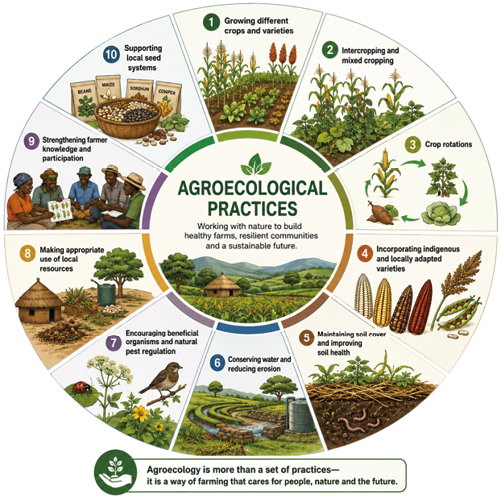
It seeks to work with natural processes rather than treating the farm as a system dependent only on external inputs. It places emphasis on biodiversity, healthy soils, efficient use of water, ecological interactions, local knowledge and farmer participation.
Agroecological practices are shown in figure 1 below:
Agroecology should not be understood as simply “farming without chemicals”. Rather, it is an approach to designing agricultural systems that use diversity and ecological processes to improve resilience and sustainability.
This makes it highly relevant to the conservation of plant genetic resources.
Five ways agroecology can protect crop diversity
Agroecology can create a positive chain of benefits that begins with farming in harmony with nature and ends with more resilient and nutritious food systems. The pathway below (Figure 2) illustrates how these elements are connected:
Figure 2: Agroecology pathway from crop diversity to climate resilience and food and nutrition security
1. Diversity becomes an asset, not a burden
One of the strongest principles of agroecology is diversification.
Diversification reduces dependence on a single crop or genetic solution. Different crops and varieties may respond differently to drought, heat, pests or diseases.
For example, One maize landrace may perform better during drought, while sorghum may tolerate dry conditions and leafy vegetables may provide micronutrients. Maintaining this diversity creates options.
If one crop or variety performs poorly, another may still provide food, seed or income.
This is particularly important in an era of climate uncertainty.
2. Local varieties can contribute to climate resilience
Climate change is making agricultural production increasingly unpredictable.
Farmers are dealing with changing rainfall patterns, prolonged dry periods, higher temperatures, extreme weather events and shifting pest and disease pressures.
Some traditional varieties and landraces have been maintained precisely because they perform under difficult local conditions. They may possess characteristics such as drought tolerance, heat adaptation, early maturity, pest tolerance or the ability to produce under relatively low-input conditions.
These characteristics are valuable not only to farmers growing the varieties today, but potentially to future crop improvement programmes.
When farmers continue to plant, select and save seed, they help maintain genetic variation that can respond to local environmental pressures. In this sense, on-farm conservation is also a form of climate adaptation.
3. Farmer-managed seed systems keep diversity moving
A seed that is stored but never planted may be conserved, but a seed that is planted, selected, exchanged and improved by farmers remains part of a living agricultural system.
Farmer-managed seed systems include household seed saving, farmer-to-farmer exchange, local seed production and community seed banks. These systems can be particularly important in areas where farmers have limited access to a wide range of commercial planting materials.
Community seed banks can complement the national genebank by helping communities conserve and access locally important crop diversity close to where it is used.
South Africa’s National Plant Genetic Resources Centre also has an important role in conserving crop diversity and making genetic resources available for research, breeding and other appropriate uses. The Department of Agriculture’s mandate includes the conservation and sustainable use of plant genetic resources for food and agriculture.
The strongest system is therefore not one that chooses between genebanks and farmers’ fields. It is one that connects them.
A seed conserved in a genebank can potentially return to farmers when needed, while farmers’ knowledge and locally maintained diversity can inform national conservation and research programmes.
4. Indigenous and underutilised crops can strengthen food and nutrition security
South Africa has a wide range of crops that have historically received less attention than major commercial commodities.
Bambara, groundnut, cowpea, sorghum, pearl millet, amadumbe, Jugo bean and indigenous leafy vegetables are examples of crops that can contribute to diversified diets and farming systems.
These crops should not be viewed simply as “traditional foods”. They can be strategic agricultural resources.
Many are suited to local environments, have cultural significance and can provide food when other crops are under stress. Growing them can also help preserve associated knowledge about cultivation, harvesting, processing, preparation and seed selection.
If consumer demand for nutritious indigenous foods increases, these crops can also create new opportunities for farmers, processors and entrepreneurs.
Conservation and economic use can therefore reinforce each other.
5. Healthy agroecosystems support healthy crop diversity
Crop diversity does not exist in isolation. It depends on functioning agricultural ecosystems.
Agroecological practices that improve soil health, conserve water, reduce erosion and encourage natural pest regulation can support diverse farming systems.
This creates an important shift in thinking.
Conservation does not have to mean taking agricultural land out of production.
Conservation can happen through sustainable production.
When farmers grow diverse crops sustainably, they can produce food while simultaneously maintaining genetic resources for the future.
Farmers are the custodians and innovators of diversity
The role of farmers deserves particular recognition.
For generations, farmers have experimented with seed, selected plants, adapted production practices and exchanged knowledge, creating much of today’s crop diversity.
Women have often played important roles in seed selection, storage, food processing and the maintenance of traditional crop varieties, while young farmers are essential to carry this knowledge forward. .
Farmers should not simply be recipients of agricultural technologies. They should be partners in research, variety selection, seed multiplication, seed fairs, local markets and participatory plant breeding.
What can farmers do?
Agroecology and on-farm conservation do not necessarily require farmers to transform their entire farming system overnight.
Practical steps can start small as shown in figure 3.
The aim is not to reject modern agriculture or commercial varieties, but to ensure that modern agriculture does not come at the cost of losing the diversity needed in the future.
A policy opportunity for South Africa
The conservation of crop diversity is receiving renewed attention nationally and internationally.
South Africa deposited its instrument of accession to the International Treaty on Plant Genetic Resources for Food and Agriculture (ITPGRFA) in December 2024, becoming the 154th Contracting Party. The Treaty recognises the importance of conserving and sustainably using plant genetic resources and acknowledges the contribution of farmers and local communities to agricultural biodiversity.
South Africa also has a National Plan on the Conservation and Sustainable Use of Plant Genetic Resources for Food and Agriculture, which identifies on-farm management as an important action, including expanded on-farm conservation, farmer participation and community seed banks.
The National Agroecology Framework, published in 2025, provides further policy support for strengthening agroecological approaches in South African agriculture. Together, these developments connect biodiversity, climate resilience, sustainable production.
These developments create an opportunity to bring several priorities together: agricultural biodiversity, climate resilience, sustainable production, food and nutrition security, farmer knowledge and sustainable seed systems.
From seed banks to living seed banks
South Africa should continue investing in national and other forms of ex-situ conservation. Seed banks and genebanks provide an essential safety net against genetic loss.
But a seed bank cannot replace a farmer’s field.
A variety growing in a farmer’s field is being tested by real environmental conditions. It is being selected, used, exchanged, cooked, eaten and evaluated.
It is a living seed bank.
The future therefore lies in strengthening the relationship between ex-situ conservation and on-farm conservation, with research, government, extension services, markets and communities supporting farmers’ seed systems.
The seed we save today is an investment in tomorrow
South Africa’s agricultural future will depend not only on higher yields, but also on enough diversity to respond when conditions change. The future drought may require a trait in a traditional sorghum variety; a disease may require genetic resistance preserved in a landrace; and future breeders may need genetic material that farmers maintain today.
Agroecology provides an opportunity to make conservation part of everyday farming by placing biodiversity, farmer knowledge and ecological resilience at the heart of production.
The choice is not between conservation and productivity.
The opportunity is to build farming systems in which conservation supports productivity, and productivity provides an incentive for conservation.
Every seed saved, every local variety planted and every piece of traditional knowledge passed to the next generation helps keep South Africa’s agricultural heritage alive.
The seed may be small, but Its contribution to the future of farming could be enormous. 
Dr Matelele Lehlogonolo* & Mr Fakude Sithembiso
National Department of Agriculture, Directorate Genetic Resources, National Plant Genetic Resources Centre.
*Correspondance: LehlogonoloMa@nda.gov.za
Figure 1: Agroecological practices