


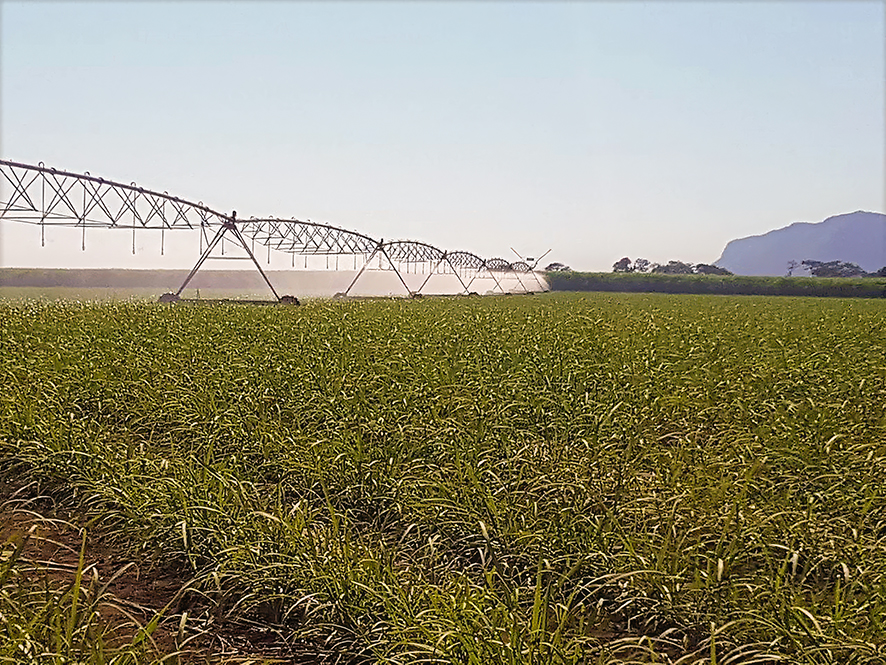
Precision irrigation versus La Niña: the profit line in 2026
The 2025/26 La Niña cycle is exposing a critical weakness in conventional irrigation thinking: rainfall alone no longer defines a “safe” season.
Large parts of South Africa entered summer with deep soil profiles and strong planting conditions. However, January has already delivered extended heat events, irregular rainfall distribution and rapidly rising evapotranspiration (ET) in multiple production zones. Under these conditions, yield loss is no longer driven by drought — it is driven by mismanaged irrigation.
Precision irrigation is no longer optional
Precision irrigation integrates three pillars:
Accurate crop demand forecasting
Real-time soil feedback
Exact water placement at the nozzle
Only when all three operate together does irrigation become a profit tool rather than a risk.
The smart control advantage
Advanced pivot control platforms (for example, the Senter360 Ezitech) fundamentally change irrigation management.
These systems enable hands on management and feedback and when combined with soil moisture probe information and/or advanced satellite driven imagery tools the result is not “automation for convenience” — it is automation for accuracy. Instead of reacting to crop stress after it appears, irrigation is driven by predictive water demand models, keeping root zones in a stable moisture band where yield formation is maximised.
Soil moisture probes and satellite imagery: seeing what your crop sees
Rainfall data is irrelevant if it is not where the roots are.
Soil moisture probes provide real-time insight into:
Root zone depletion
Infiltration efficiency
Drainage losses
Compaction layers
Over-irrigation/saturation
This season’s combination of heavy early rains followed by intense heat means many fields are simultaneously dealing with:
Saturated slow-draining soils
Dry, fast-draining sandy ridges
Subsoil compaction restricting water movement
Without probes and advanced satellite imaging information, irrigation decisions are blind — and blindness is expensive.
Weather intelligence: irrigating before stress occurs
Advanced short-term and 7–14 day weather modelling allows pivots to be scheduled around:
Heat waves
Wind events
High ET periods
Rainfall probability and intensity
This allows producers to pre-load soil profiles before high-ET events instead of chasing stress after it has already cost yield.
In modern irrigation, timing is as important as volume.
The forgotten profit lever: sprinkler package quality
It’s not the pivot structure that applies water, but the sprinkler package.
Low-uniformity sprinklers silently destroy yield by:
Creating chronic dry zones
Causing runoff on clay sections
Inducing waterlogging on low-lying areas
Wasting pumping energy
A high-quality, correctly pressure-regulated sprinkler package is the foundation that makes all precision tools meaningful. No control panel or probe can compensate for poor water distribution.
The financial reality
Under 2026 conditions, yield loss will not come from lack of water. It will come from:
Poor timing
Mistakes can include under-irrigating when not measuring actual soil moisture, thinking moisture levels are still fine, starting irrigation too late or over-irrigating when topsoil appears dry but subsoil can still be saturated, and starting irrigation too soon. All of these set back or even harm the crop.
Over- application
Saturating the soil with too much applicant will temporarily stop growth, setting back the harvest. Continuous over-application can lead to waterlogging, with more serious implications.
Inconsistent distribution
Old, worn-out sprinkler packages tend to lose their ability to distribute water evenly and can cause under and over watering in the same field.
Inadequate soil feedback
Irrigation scheduling is critical to success. By not measuring soil moisture with soil moisture probes or any other similar devices to determine the actual soil water status, costly planning errors can occur.
Mechanical downtime
Older machines that are not properly maintained become unreliable machines prone to breaking down just when you need to do that critical irrigation.
Precision irrigation converts centre pivots from “rainfall insurance” into controlled yield engines.
The difference between an average crop and a record crop this season will be determined by millimetres, hours, and management discipline.
This La Niña is not forgiving.
Precision is now the margin of profit.
Theuns Dreyer, Managing Director, Senter 360