


Potatoes SA ushers in a new era for potato farming
Potatoes are found in every household in South Africa. Last year, Potatoes SA launched a new campaign under the tagline Amazambane for Life (Potatoes for Life). The campaign is aimed at educating South Africans not only about the health benefits that potatoes offer, but also to showcase the versatility of these spuds and highlighting the different role players involved in the process of growing and bringing our favourite staple to our plates. One of the most interesting aspects of the campaign is showing how the potato industry is adopting cultivation methods that increase yields while fostering soil health and being water wise. The end result: healthier potatoes on the consumer’s plate and better opportunities for potato growers. We spoke to Potatoes SA to find out more.
What is the Potatoes SA approach to soil preservation?
Soil conservation can be compared to preventive maintenance on a car. Changing the oil and filter, and checking the hoses and spark plugs regularly will prevent major repairs or engine failure later. Similarly, practicing conservation now will preserve the quality of the soil for continued use soil conservation involves treating the soil as a living ecosystem, and recognizing that all the organisms that make the soil their home, play important roles in producing a fertile healthy environment.
How water-wise methods of growing potatoes have come to the fore?
Even though potatoes produce more nutritious food on less land with less water in harsher climates than any other major food crop, the potato farmers together with Potatoes SA still strive to improve water use efficiency. Examples of projects on sustainable water use include first of all a survey to determine how big the water footprint of potatoes is in South Africa. Irrigation courses are offered in each potato production area. During these courses farmers are trained to manage their irrigation optimally by tailoring the timing and depth of water applications keeping in mind the soil type, the crop, the crop’s growth stage, weather conditions and the type and maintenance of the irrigation systems. These courses also included which irrigation scheduling tools could be used such as tensiometers, electrical resistance sensors, neutron probes, capacitance probes and soil samples to ensure optimal water-use efficiency. The potato industry is continuously evaluating new inventions such as drag-on lines, satellite imaging, cosmic ray probes and the chameleon soil water sensor, keeping up to date regarding any improvements to ensure water use efficiency. Another crucial project is the monitoring of groundwater resources in the Sandveld (Western Cape) in order to identify hotspots so that the boreholes in the hotspot areas can be better managed. Currently Potatoes SA together with tertiary institutions has started a project to determine the water and nutrient use efficiency in potato fields in order to identify challenges and devise methods to improve water and nutrient use efficiently. Optimum water usage is extremely important to every potato farmer not only because water is one of our scarcest resources but also a negative impact on quality with an increase in disease development, leaching of nutrients and wastage of electricity when we over-irrigate.
How best can potato growers maintain and improve the fertility of their land?
A 4-6 year crop rotation cycle reduces the risk of insect and disease problems, since the pests do not have enough time to become established in damaging numbers.
Cover crops are crops planted to reduce the impact of wind and water on bare soil. They absorb the impact of rain, reduce the speed of runoff, hold the soil in place, and encourage greater infiltration; hence less runoff.
Natural fertilizers such as livestock manure, mulch, and legume plants are grown and then tilled into the soil as “green fertilizer”. Like with chemical fertilizers, soil is replenished with essential nutrients.
Integrated pest management (IPM) uses a variety of techniques designed to cut the use of chemical pesticides, and hence reduce environmental risks. These include pest resistant or tolerant potato cultivars, trap crops and biological controls such as the release of pest predators or parasites to control pest populations.
Liming is yet another effective method of soil conservation. It refers to the addition of some calcium or magnesium-rich materials to the soil. These materials could include limestone, chalk, marl, etc. When this is done on acidic soils, these materials react in the form of a base and neutralize the acidity of the soils.
Regarding chemical fertilizer, it is essential that only chemical fertilizers registered on the specific crop and required amounts of the correct chemical fertilizer are added to the soil as and when required.
Then there are soil microorganisms. Besides earthworms, there are several beneficial microorganisms in the soil that keep it healthy. Their levels in the soil can easily be enhanced by planting the right rotation crops or also by using the right type of fertilizers. Nowadays you can even buy mirco-organisms to add to soil.
What are some ways to improve yield?
High yield is important in potato production since it is a very high input cost crop. It is not the only factor defining improvement of production. Genetics in potato cultivars are improving rapidly with the focus on growing cultivars that are adapted to harsher climates and have longer roots to optimize for instance water uptake making more efficient use of resources.
How will potato growers benefit if the public perceives potatoes to be a healthy, environmentally friendly product?
Potatoes have long been an important, cost-effective source of energy, nutrition and satiety in the South African diet. As the most important vegetable crop in South Africa and one of the world’s most recognised staple foods, the potato continues to play an important role in our diets, health and well-being.
For the majority of South Africans, a potato is food on a dinner plate. The truth is, for just over 500 potato producers in South Africa, as well as an estimated 50 000 temporal and permanent farmworkers, potatoes are also a vital source of income and livelihood.
There is no potato grower without a South African consumer that is healthy, has faith and confidence in the power of potatoes to offer taste, convenience, versatility, value for money and certainly optimal health and nutrition.
Apart from the #AmazambaneForLife campaign, how else can potato growers market their products better?
South Africa is one of the few countries in the world that can produce fresh potatoes all year round. The industry boasts 16 production regions that abide by the Agricultural Products Standards Act.
The Act provides for control over the sale and export of potatoes. All potato growers market and sell produce that is correctly classed, compliant to quality factors such as decay, greening and sprouting to name but a few; best packing and marking requirements.
The #AmazambaneForLife campaign is, therefore, one of many planned marketing initiatives aimed at informing, educating and inspiring South African consumers about the many positive attributes of potatoes. In a 2019 Usage & Attitudes study conducted by Potatoes South Africa, 500 South Africans within the middle-income sector were asked why they consume potatoes, 84% of the respondents stated the deliciousness and great taste of potatoes as the reason why. There is no other way but to heed the call of South Africans. A fresh, tasty and quality product grown with passion by committed potato growers.
Opportunities for New Era farmers
One of the core divisions of Potatoes South Africa (PSA) is Transformation, which is tasked with the development of New Era Farmers. For the past few years, the Transformation division has been assisting farmers who are participating in the Enterprise Development Programme with start grant funding and also access to training and mentorship.
The new era farmers who qualify through the set criteria are assisted with drafting a bankable business plan, seed support, training, mentorship and industry exposure. The seed support plays a very crucial role in ensuring that the new era farmers get off the ground and embark on their sustainable farming journey. The farmers have to comply with the following criteria before being part of the Enterprise Development Programme:
• Own the land or lease agreement for more than five years in place
• Lead farmer/entity with linkages and expertise
• Actively farming and have a track record
• Land should be accessible for information/farmer days
• Land should be accessible for business and technical workgroups
• Acceptable soil depth (800mm)
• Soil acidity must be at acceptable levels
• Evaluation of history of the land (crops planted) for at least the past years for risk and nematodes
• Average annual rainfall for site
• Irrigation infrastructure
• A suitable dedicated mentor for each project be available
• All land to be fenced before planting
• Irrigation equipment tested and irrigation water-secure before accepted onto the programme
• Access to all production harvesting and sorting equipment
• Access to high potential soil suitable for potato production
Once the farmer meets the above criteria, he is then supported for a period of five years while linkages are being created with other financiers and cooperatives who will eventually work with the farmer when he exits the Potatoes SA Enterprise Development Programme. Potatoes SA, however, does not cut its ties completely with the farmer after the farmer has left the programme. At the point of exit, the farmer gets access to all the activities of PSA, including access to production information and all educational events that take place.
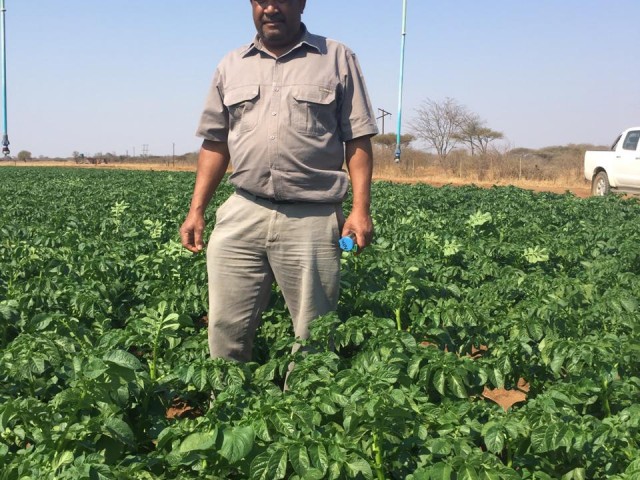
Aldrin Lawrence, a farmer in the Vhembe district, is one of the farmers who is currently participating in the Enterprise Development Programme. He has been in the programme for three years and boasts a huge success as his tonnage over the past three years has exceeded the average of the region. Due to the great progress, he has been experiencing; a decision was made to expand his hectares from 7.2 to 14.4 in the current season.
When Lawrence started with farming potatoes, he had very little knowledge about growing potatoes. He was fortunate enough to have a mentor who imparted all the knowledge and also assisted him with machinery where needed. PSA officials also played a huge role in providing technical support to the farmer. Lawrence’s plan is to acquire his own land, expand his current potato production and become a commercial farmer. He aspires to have all necessary equipment such as the planter, harvester, packhouse with washing and sorting equipment. He is grateful to be part of the Enterprise Development Programme with PSA as this has played a significant role in setting him up to become a successful sustainable potato producer.